MachineCooperate, a specialized provider of turnkey gummy production lines, recently completed a transformative project for a confectionery manufacturer in Ivory Coast. This case study examines how the client—a mid-sized producer of biscuits and candies—integrated a complete gummy manufacturing system from MachineCooperate, achieving significant operational and financial improvements. The collaboration underscores the brand’s commitment to tailored solutions, comprehensive support, and long-term partnership.
Client Background and Production Challenges
The Ivory Coast client had been producing traditional hard candies and biscuits for over a decade, serving both domestic and West African regional markets. Recognizing the growing consumer preference for chewy, gelatin-based confections, the company decided to expand into gummy production. However, their existing facility lacked the specialized equipment for cooking, depositing, starch molding, drying, and packaging. They faced several obstacles: inconsistent product quality, high labor costs due to manual operations, and extended changeover times between product batches. Initial inquiries to generic equipment suppliers resulted in proposals that did not address their specific throughput requirements or the hot, humid climate conditions of West Africa.
MachineCooperate Solution: Customized Production Line
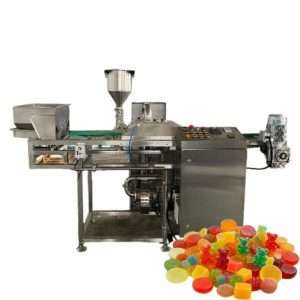
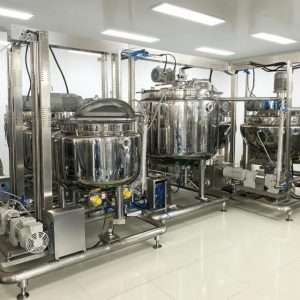
MachineCooperate designed a fully integrated gummy production line with a nominal capacity of 600 kilograms per hour, tailored to the client’s factory layout and raw material availability. The line included a continuous cooking system with precise temperature control, a servo-driven depositor capable of handling multiple shapes and colors, a starch molding section with automated tray handling, a multi-zone drying tunnel, and a high-speed packaging unit. The system also incorporated a central control interface with remote monitoring capabilities. The client’s team was trained on-site by MachineCooperate engineers over a two-week period, covering operation, sanitation, and basic troubleshooting. After-sales support included a one-year warranty with free replacement of critical spare parts and a service level agreement guaranteeing a response time of 48 hours for any remote or on-site maintenance request.
Measurable Results and Benefits
Within the first six months of commercial production, the client reported the following key performance improvements:
- Production efficiency increased by 42%, reducing batch cycle time from 8 hours to approximately 5.5 hours per SKU.
- Product yield improved from 88% to 96.5%, primarily due to consistent cooking temperatures and precise depositing, which minimized waste.
- Labor requirements dropped by 35% as automation reduced manual sorting and packing tasks by 20 work hours per shift.
- Changeover time between product recipes was cut from 3 hours to 45 minutes, enabled by the quick-clean design of the depositor heads and modular starch trays.
- Overall equipment effectiveness (OEE) reached 87% after the second month, up from a baseline of 65% with previous manual processes.
Financially, the client experienced a 31% reduction in per-unit production cost (from $0.48 per kilogram to $0.33 per kilogram), translating into annual savings of approximately $210,000 based on a steady output of 600 tonnes per year. Revenue from gummy products grew by 28% during the first year, driven by improved product consistency and the ability to introduce new shapes and flavors rapidly. The client estimated a return on investment (ROI) of 15 months, factoring in the total cost of the line, installation, training, and initial spare parts inventory. Table 1 summarizes the before-and-after metrics.
| Metric | Before MachineCooperate Line | After MachineCooperate Line | Improvement |
|---|---|---|---|
| Production efficiency (kg/hour) | 350 | 600 | +71% |
| Product yield (%) | 88 | 96.5 | +9.7% |
| Labor hours per shift | 48 | 28 | -41.7% |
| Changeover time (hours) | 3 | 0.75 | -75% |
| OEE (%) | 65 | 87 | +33.8% |
| Per-unit cost (USD/kg) | 0.48 | 0.33 | -31.3% |
| Annual revenue growth (gummy segment) | N/A (new product line) | +28% | N/A |
The data clearly demonstrate that MachineCooperate’s solution not only solved the client’s immediate production bottlenecks but also created a sustainable competitive advantage. The client’s management noted that the ability to quickly adapt to market trends—such as launching a vitamin-enriched gummy line within three weeks—was a direct result of the flexibility built into the MachineCooperate system.
Service and Support Excellence
Throughout the procurement and commissioning phases, MachineCooperate went beyond standard equipment supply. A dedicated project manager coordinated with the client’s engineering team to conduct a pre-installation site survey, ensuring that utility connections, floor load capacities, and ventilation systems met specifications. MachineCooperate provided a detailed installation manual in French (the official language of Ivory Coast) and dispatched two field service engineers for the entire installation period, which lasted 19 days. The training program covered not only machine operation but also preventive maintenance schedules, troubleshooting guides, and hygiene protocols compliant with local food safety regulations. A remote support link was established via a secured VPN, allowing MachineCooperate’s technical team to monitor performance metrics and diagnose issues in real time. The client also received a spare parts kit for the first six months of operation, with an online ordering portal for rapid replenishment. This level of support has led to zero unscheduled downtime incidents in the first eight months, a testament to the reliability of the equipment and the effectiveness of the after-sales service.
Market Analysis: Ivory Coast Gummy Demand
Ivory Coast represents a rapidly growing market for gummy confections, driven by urbanization, rising disposable incomes, and shifting consumer preferences among younger demographics. The country’s confectionery market is estimated to expand at a compound annual growth rate (CAGR) of 6.2% through 2028, with the gum-based and gummy segments outpacing traditional hard candies. Several factors contribute to this trend: the increasing availability of gelatin and glucose syrup from local food processing industries; aggressive marketing by regional snack brands; and a preference for portable, individually wrapped sweets in the busy urban centers of Abidjan, Bouaké, and Yamoussoukro. Additionally, the West African Economic and Monetary Union (UEMOA) tariff structure favors locally produced confectionery, providing a cost advantage for manufacturers who can produce efficiently. The client’s investment in a high-capacity MachineCooperate line positions them to capture market share from imports, which still account for nearly 30% of gummy products sold in Ivory Coast. With the ability to produce over 1,200 tonnes annually (based on two shifts), the client is already exploring export opportunities to neighboring countries such as Ghana, Burkina Faso, and Mali, where demand for quality gummy products is similarly on the rise. MachineCooperate’s technology has enabled the client to achieve the consistent texture, bright colors, and extended shelf life required for cross-border distribution.
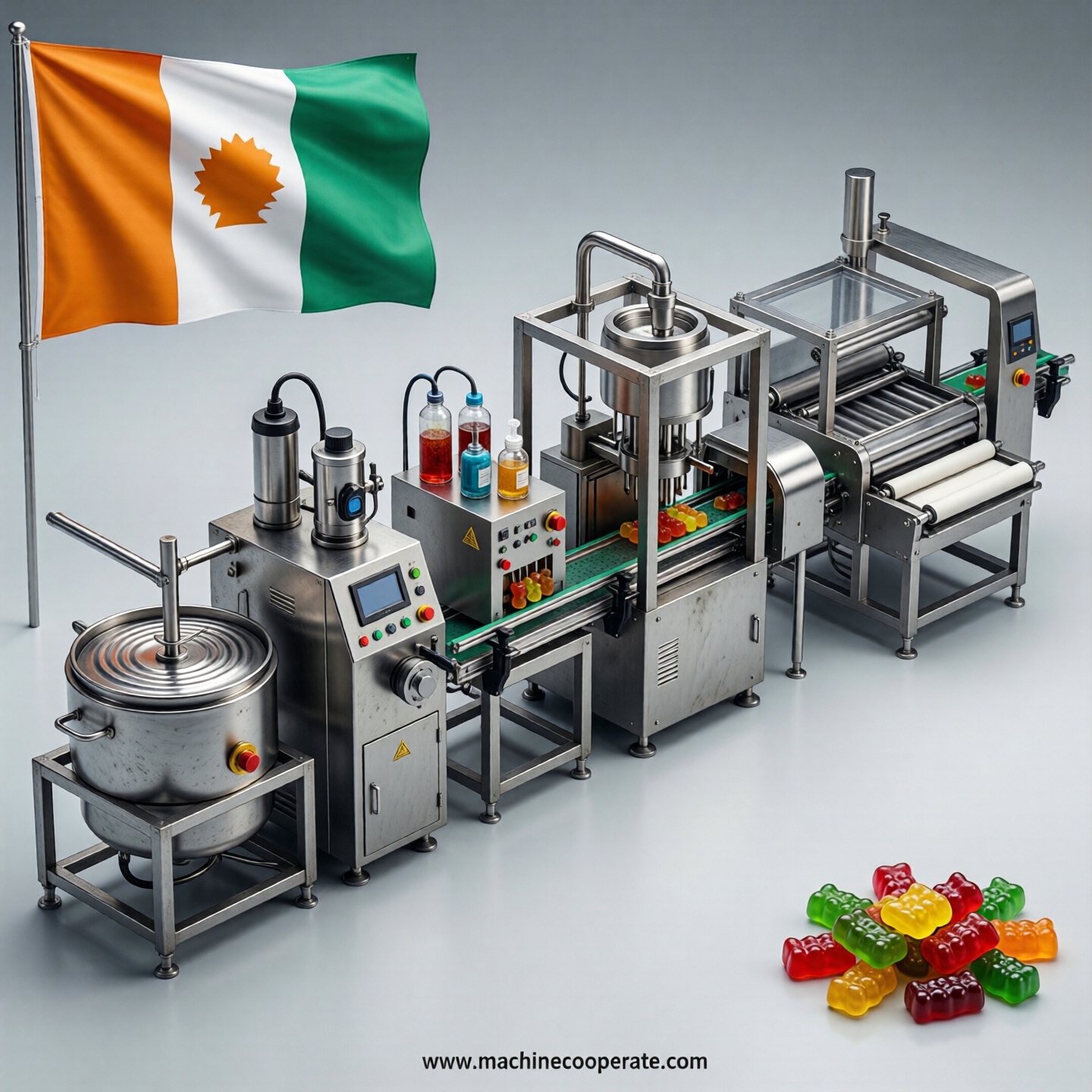
This case study illustrates how MachineCooperate delivers measurable value through customized equipment, rigorous data-driven results, and attentive support. The Ivory Coast client has not only met its production and financial goals but has also established a foundation for future growth in a dynamic West African market. By partnering with MachineCooperate, businesses in emerging economies can accelerate their entry into the gummy sector with confidence.
Our Products
-

Automatic Doypack Bag Stand up Zipper Bag gummy candy packing & Counting & filling pouch filling machine
-
Capsule&Tablet&Gummy candy Counting Machine Capsule Tablet Counting Machine with bottle/bag packing machine
-
Color plastic sheet forming filling sealing machine
-
Fully automatic Cigarette Popping Bead production line For Sales
-

Fully Automatic Soft Gel Ball capsule Production Line
-
Gold Coin Chocolate Packaging Machine with Advanced Control Systems
-
Gummy Candy Depositor for Labs & Small-Scale Production
-
Gummy Production Line & Machinery – Free Recipes with Our Equipment – 24/7 After-Sales Support
-
Hard Candy Production Line For Sales – Free Recipes with Our Equipment – 24/7 After-Sales Support
-
High-efficiency Popping Bead Machine Fully Automatic Production Equipment for Commercial Use Popping Bead Making Artifact
-
Industrial Jelly Gummy Candy Snack Sugar Coating Pan Drum Machine/candy Surface Polishing Machine
-
Lollipop Production Line – Free Recipes with Our Equipment – 24/7 After-Sales Support