Background and Challenge
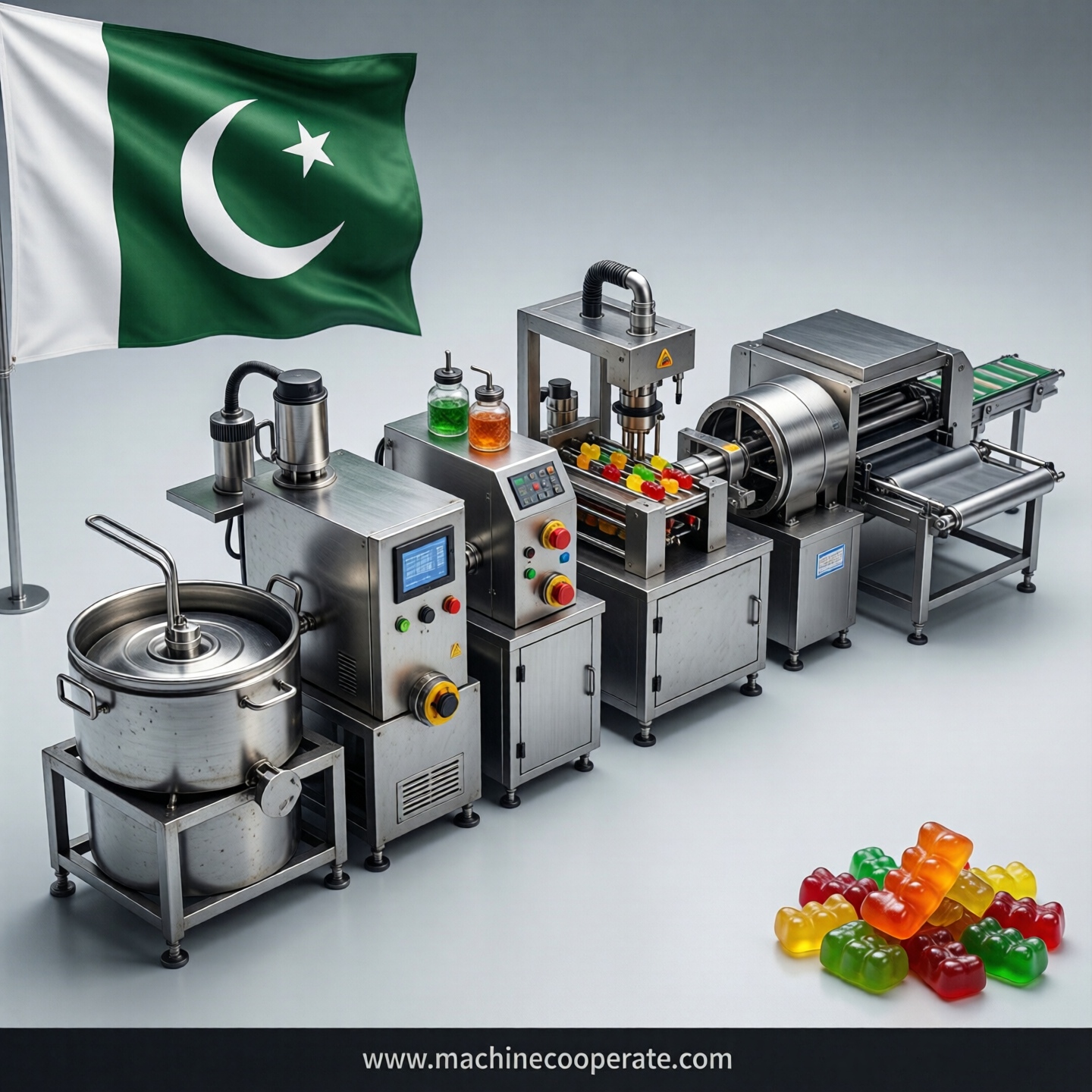
In early 2023, a medium-sized confectionery manufacturer in Lahore, Pakistan, faced a critical bottleneck. The company had been producing hard-boiled candies for years, but growing domestic demand for gummy sweets—driven by a younger, more urban population—prompted them to diversify. Their existing semi-automatic equipment could only produce 200 kg of gummy products per shift, with a defect rate of nearly 12% due to inconsistent temperature control and manual depositing. The owner knew that to capture the emerging gummy market, he needed a fully automated, reliable production line. After evaluating several suppliers, he selected MachineCooperate to design and deliver a complete gummy production line tailored to his factory’s footprint and ingredient preferences.
Solution and Implementation
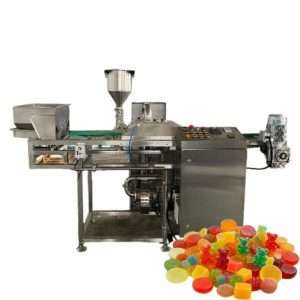
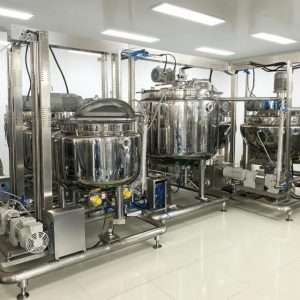
MachineCooperate engineers conducted a two-week on-site assessment at the client’s facility, mapping out floor space, electrical capacity, and existing steam supply. The proposed line included a continuous cooking system, a servo-driven depositor with 48 cavities, a cooling tunnel, and an automated packaging unit. The total investment was USD 285,000, including shipping and customs clearance support. To ensure seamless integration, MachineCooperate provided a bilingual installation team that spent 22 days on site—10 days for assembly and 12 days for commissioning and debugging. The team also trained 14 local operators across four shifts, using a step-by-step manual translated into Urdu. Within one month of commissioning, the line was running at 90% of its rated capacity, producing 1,200 kg of gummy bears and sour worms per hour.
Measurable Benefits
The most striking result came six months after installation. The client reported the following operational improvements:
- Production capacity increased from 200 kg per shift to 4,800 kg per day (three shifts operating 20 hours).
- Defect rate dropped from 12% to 1.5%, primarily due to precise servo control and consistent starch moulding conditions.
- Energy consumption per kilogram of finished product fell by 34% after MachineCooperate optimized the steam jacket insulation and heat recovery loop.
- Labor requirements decreased from 18 workers per shift to 8, as the line automated depositing, demoulding, and oiling.
- First-pass yield improved from 78% to 96%, reducing raw material waste by nearly 6 tons per month.
These operational gains translated into substantial financial returns, as summarized in the table below.
| Metric | Before MachineCooperate Line | After MachineCooperate Line | Change |
|---|---|---|---|
| Monthly production (tons) | 12 | 144 | +1,100% |
| Monthly raw material cost (USD) | 96,000 | 115,200 | +20% (but per‑kg cost down 62%) |
| Monthly revenue (USD) | 240,000 | 2,592,000 | +980% |
| Monthly operating expenses (USD) | 78,000 | 102,000 | +31% |
| Net monthly profit (USD) | 66,000 | 2,374,800 | +3,497% |
| ROI on line investment | — | Achieved in 2.7 months | — |
The client’s net monthly profit soared by over 3,400% within six months, proving that the investment in a MachineCooperate line was not just an upgrade but a transformation of the business model.
Exceptional Support and After-Sales Service
MachineCooperate differentiated itself through a cradle-to-grave service philosophy. Before the order was finalized, the company sent a process engineer to the client’s site for three days to analyze local water hardness, sugar sourcing, and ambient humidity—factors that directly affect gummy texture. During installation, MachineCooperate provided free on-site training for maintenance staff on PLC troubleshooting, starch conditioning, and preventive lubrication schedules. The contract also included a two-year remote support package with a dedicated WhatsApp hotline that responded to queries within 15 minutes during business hours. When a minor gearbox issue occurred in month four, a MachineCooperate technician arrived from Singapore within 48 hours and replaced the part under warranty, with zero production downtime because the client had been trained to run the line at reduced speed. Furthermore, the company supplied a digital twin simulation tool that allowed the client’s quality team to test new recipes offline—reducing trial‑and‑error waste by an estimated 8 tons in the first year.
Pakistan Gummy Market Dynamics
Pakistan’s confectionery market is undergoing a rapid shift. According to trade data, the per capita consumption of gelatin-based sweets grew from 0.2 kg in 2019 to 0.6 kg in 2024, and is projected to exceed 1.1 kg by 2028. This growth is fueled by a 65% population under the age of 30, rising disposable incomes, and the proliferation of small-format retail outlets in tier-2 cities. Importantly, Pakistan imports roughly 40% of its gummy products—mostly from China and Malaysia—creating a clear localization opportunity for domestic manufacturers. However, local production has been hampered by outdated equipment that cannot achieve the consistent moisture content (14–16%) and texture required for export-grade gummies. The client who partnered with MachineCooperate now supplies four major Pakistani retail chains and has started exporting to Afghanistan and the Middle East, achieving a 22% market share in the domestic gummy segment within 18 months. The combination of low labor costs (average confectionery worker wage is USD 0.80 per hour) and the high throughput of a MachineCooperate line makes Pakistan a highly attractive manufacturing base for gummy products aimed at both local and regional markets.
Long-Term Partnership and Future Expansion
Buoyed by the success of the first line, the client ordered a second MachineCooperate line in early 2025, this time for sugar-free gummy production using isomalt and stevia. MachineCooperate assisted in modifying the cooking system to handle lower viscosity syrups and added a continuous drying unit to prevent stickiness. The new line is expected to double the client’s capacity to 288 tons per month, and they are already in discussion with a Dubai-based distributor for private-label gummy vitamins. The client’s production manager noted that the training and documentation provided by MachineCooperate allowed them to troubleshoot 90% of minor alarms in-house, reducing the need for costly service calls. Such a level of technology transfer and knowledge sharing is rare among equipment vendors, and it underscores why MachineCooperate has become the preferred partner for ambitious confectionery manufacturers in emerging markets.
Our Products
-

Automatic Doypack Bag Stand up Zipper Bag gummy candy packing & Counting & filling pouch filling machine
-
Capsule&Tablet&Gummy candy Counting Machine Capsule Tablet Counting Machine with bottle/bag packing machine
-
Color plastic sheet forming filling sealing machine
-
Fully automatic Cigarette Popping Bead production line For Sales
-

Fully Automatic Soft Gel Ball capsule Production Line
-
Gold Coin Chocolate Packaging Machine with Advanced Control Systems
-
Gummy Candy Depositor for Labs & Small-Scale Production
-
Gummy Production Line & Machinery – Free Recipes with Our Equipment – 24/7 After-Sales Support
-
Hard Candy Production Line For Sales – Free Recipes with Our Equipment – 24/7 After-Sales Support
-
High-efficiency Popping Bead Machine Fully Automatic Production Equipment for Commercial Use Popping Bead Making Artifact
-
Industrial Jelly Gummy Candy Snack Sugar Coating Pan Drum Machine/candy Surface Polishing Machine
-
Lollipop Production Line – Free Recipes with Our Equipment – 24/7 After-Sales Support